Its not about money anymore
Money?
It's not about money anymore.
That's what I hear people say. That's partly true. Money was never a human thing, at least not until the past 5000 years. Once we all escape pure scarcity, humans change into something that used to drive their motivation before everything existed.
- Status within a group;
- reproductive success;
- power over others;
- meaning making;
- or just pure dopamine grinding.
You mention. When financial security removes money from our "consideration" card, or time becomes scarcer than money. Work becomes about peace, respect, relationships, and happiness.
I will answer 4 questions that AI asked me, and probably you, readers, can think about them with me.
How might ancient human societies, before the invention of money, have structured their hierarchies around status and power, and what lessons could modern humans draw from that in a world where AI handles most labor?
I couldn't know for sure how life was back then, but I'm pretty sure inheritance plays a very strong role when it comes to power. Most of the businesses that are running around in the world must have something to do with a family-run hierarchy. Well, now that schools exist, I'm pretty sure that is not the case anymore.
Anthropological studies of groups like the !Kung San, Hadza, or Australian Aboriginal foragers show that status came from skills (hunting prowess, storytelling, healing knowledge), generosity in sharing resources, or age/wisdom rather than accumulated wealth or rigid inheritance.
Quoted from some web searches, it makes sense that human skills that are shared through many means are what make someone truly have their worth!
- Storytelling
- Knowledge
- Generosity in sharing resources and thinking
- Wisdom
Well, in the modern world, we can expand them to creativity, empathy, and social bonds. But then again, there are intangible traits like charisma—the power to lure and attract people, which sometimes can appear in unfavorable people.
If reproductive success was a primary driver in pre-monetary eras, how do evolving technologies like genetic engineering or virtual realities challenge or enhance that motivation today, especially when financial barriers are removed?
You know what concerns me a lot is not just genetic engineering. It might not be very far away until we finally reach the point where we can genetically modify babies to make them smarter, stronger, and more attractive. But I can say for sure, being smart and strong can be trained, but there are certain aspects in life that are just permanent. Being attractive runs in our genes, having perfect body parts, skin tones, first languages, and family wealth, most of which are predetermined right after we are born. So, life is never fair.
In what ways does 'pure dopamine grinding'—like endless scrolling or gaming—mirror ancient survival instincts, and how could societies redesign work or leisure to channel it toward collective meaning-making instead of individual highs?
Well, there must be people who are just addicted to sex, drinking, storytelling, dancing, foraging, bonding, playing, or training to be a warrior back in the day. I could never know, it would be super interesting to see what people centuries ago did in their daily lives, though. What do you think? Do you have any information about what they were doing back then?
Once time becomes scarcer than money in a post-scarcity economy, how might interpersonal relationships evolve? For example, could 'respect' replace wealth as the new currency, and what conflicts might arise from that shift?
Well, now interpersonal relationships rely heavily on how much salary a person earns, how much money they have, and how much money their parents have. It still sticks in people's minds to compare themselves with others based on where they work, or simply just how much they earn, or how good their life is. Not everyone can purchase or get the nicest things others can, especially with money; you get to enjoy some things that other people don't. These limitations make options decrease. For the same reason, it makes very much sense why criminality can rise. Because people want fairness, it's not uncommon to see people cheat, deceive, corrupt, or do seemingly illegal things in the eyes of the law.
How to survive, then?
Quoted from a Medium blog by @interestsandannoyances
Our brains didn’t evolve to handle the complexities of modern life. Instead, they were shaped by the harsh realities our ancestors faced as hunter-gatherers, where finding high-calorie food or identifying potential mates could mean the difference between survival and death.
- Fuck excuses, discipline over motivation.
- Turn everything into active thinking.
- Train your attention span and do deep thinking.
So then, I was thinking about how primitives do it. Is deep thinking a skill only modern humans have? I don't think they would have the ability to do philosophical deep thinking.
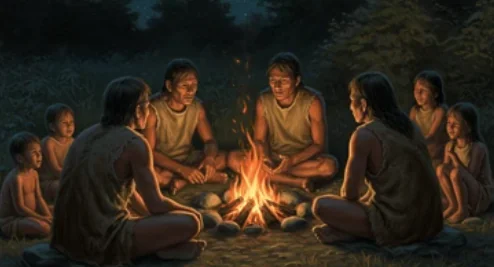
Hunter-gatherers didn't have spare time for "armchair philosophy" because survival demanded constant practical intelligence, but that intelligence required profound reflection. Tracking animals, for example, involved speculative reasoning: reading subtle signs (broken twigs, faint scents, behavior patterns), hypothesizing past events, predicting future movements, and testing ideas against evidence.
Around campfires (especially at night, when firelight talk dominated), hunter-gatherers spent hours sharing stories, myths, legends, and personal experiences. Knowledge passed orally, so it stayed fluid, contextual, story-based rather than logical-argument-based.
It made sense how they are discussing, creating stories, ideas, and building things out of their community. Our human brain still has the wiring for it! We need to use this for our own good.